Juniors
Junior Golf Lessons for Kids in London: What Suits Which Ages
Junior golf lessons for kids in London: what age to start, tri-golf, junior academies and membership, safeguarding questions, club sizing and costs.
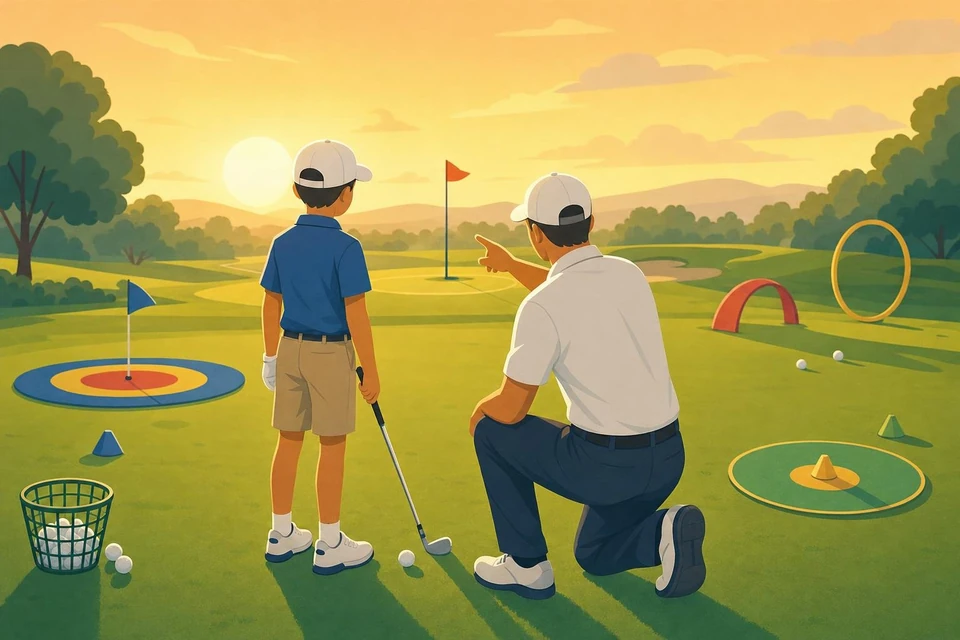
Children pick up golf in a way adults rarely manage. They do not worry about looking silly, they copy what they see without analysing it, and they hit a lot of balls without getting bored as long as there is a game attached. The difficulty for parents is not whether a child can learn but how to find junior golf lessons that suit their age, and that are run safely.
In London the options range from tri-golf sessions in primary schools to junior academies at clubs and ranges, holiday camps, and full junior membership. Which kind of golf lessons for kids makes sense depends mainly on their ages.
What age kids can start golf lessons
There is no official minimum. Many coaches take children from about five, some from four, and the earliest sessions look very little like golf: plastic clubs, big soft balls, targets, relays and lots of noise. The point at that age is coordination and enjoyment. A four-year-old who spends half an hour trying to hit a hoop with a foam ball has had a successful lesson.
From around seven or eight, most children can follow a simple technical instruction and repeat it, which is when proper junior academies start to make sense. By eleven or twelve, a child who enjoys it can be playing short courses and keeping a score, and some will be ready for club junior sections and competitions.
Starting later is fine too. Plenty of good golfers took up the game at fourteen or fifteen, sometimes after another sport. Teenagers generally learn the technical side faster than younger children and often benefit from being in a group of their own age rather than with eight-year-olds.
Formats by ages: from tri-golf to junior membership
The formats fall roughly into four stages. Not every child needs all of them, and the age bands are approximate.
| Age (approx.) | Format | What happens |
|---|---|---|
| 4–7 | Tri-golf and play-based taster sessions | Plastic equipment, games and targets, often in schools or sports halls |
| 6–12 | Junior academy or group course | Weekly sessions with a coach, real clubs cut to size, short-game focus |
| 8–16 | Short-course play and colour-coded tees | Par-3 and nine-hole golf, first scores, simple etiquette |
| 10–18 | Junior membership and club junior section | Regular access, coaching, competitions and a handicap |
Tri-golf is a school-based version of the game backed by the Golf Foundation, the charity that also runs the HSBC Golf Roots programme for young people. Many children’s first contact with golf comes through this in a primary school PE lesson, and the Golf Foundation explains how schools and clubs take part.
England Golf runs national beginner programmes for juniors too: Get into Golf Rookies for children and young people aged five to eighteen, typically six weekly one-hour sessions with the last one on the course, and Girls Golf Rocks for girls of the same age range. Both are delivered by clubs and facilities, so availability varies by area.
Junior academies are the backbone. A good one groups children by age and ability, keeps sessions to an hour, and balances technique with games. Clubs in outer London and the surrounding counties often run them at weekends, and the larger ranges inside the M25 run them after school as well.
Junior golf lessons in London: where to look
Inside London itself, most junior coaching happens at driving ranges and pay-and-play courses, because they have floodlights, covered bays and no members to disturb. The page on driving ranges in London gives a feel for the types of venue. Clubs further out, in Surrey, Kent, Hertfordshire and Essex, tend to have structured junior sections with a clear pathway into membership.
For a first try, holiday camps are a good low-commitment option, since a few days in a row show whether a child genuinely enjoys it. The guide to junior golf summer camps covers how they work. Weekly junior golf lessons then build on that.
A practical point for London families: travel time often decides whether a child keeps going. A modest academy fifteen minutes away usually beats an excellent one an hour across town, especially in winter when sessions finish in the dark.
How a good junior session runs
A well-run junior session for primary-age children rarely spends more than ten minutes on any one thing. A typical hour opens with a warm-up game, moves to a short technical block, then turns that technique into a challenge: chip into a hoop, putt through a gate, land the ball beyond a cone. Scores and small rewards keep the energy up. Older children spend longer on technique and start to keep score on short holes.
- Warm-up gameSomething active to break the ice and get everyone moving.
- Short technical blockOne skill, explained simply, never more than ten minutes.
- Turn it into a challengeChip into a hoop, putt through a gate, land the ball beyond a cone.
- Scores and small rewardsKeep the energy up until the end of the hour.
Parents watching for the first time are sometimes surprised by how little full swinging happens. That is deliberate. Putting and chipping build feel and confidence, they are safe in a crowded group, and they are the shots that decide scores later on. A coach who starts eight-year-olds with drivers is usually chasing excitement rather than progress.
Progress is often tracked through award schemes, with badges or colour levels for skills such as putting distance or getting the ball airborne. Children like having something to aim for, and the schemes give parents a simple way to see what has been covered.
Ask the coach how they handle a child who is clearly ahead of the group, and one who is struggling. A thoughtful answer, rather than a shrug, says a lot about the programme.
Safeguarding questions parents should ask
This is the part parents most often skip, and the one that matters most. Golf in England has formal safeguarding policies through England Golf and the PGA, but the questions are still worth asking directly.
Is the coach a PGA professional or otherwise qualified, and do they hold a current enhanced DBS check? Does the club or venue have a named welfare or safeguarding officer, and how do you contact them? What is the ratio of coaches to children? A ratio around one adult to eight children is common for juniors; very young groups should have more adults. Are there rules on photography, social media and one-to-one contact? How are children supervised between the end of the session and collection?
- PGA professional or otherwise qualified coach
- Current enhanced DBS check
- Named welfare or safeguarding officer
- A clear coach-to-child ratio
- Rules on photography and social media
- Rules on one-to-one contact
- Supervision until collection
adults to children is a common ratio for junior groups; very young groups should have more adults.
A well-run programme answers all of this without hesitation, and usually has it written down. If a venue seems vague, that is reason enough to look elsewhere.
Equipment sizing for children
Cut-down adult clubs used to be the norm, and they are a poor idea: too heavy, too stiff, and with grips that are too thick for small hands. Proper junior sets are made in sizes based on the child’s height, sold by height bands rather than by age. A child who grows quickly may move up a size every year or two, which is why second-hand junior sets are common and sensible.
A starter set needs only a few clubs: a driver or fairway wood, a couple of irons, a wedge and a putter. More than that just adds weight to a bag a child has to carry. Most academies lend clubs for the first sessions, and a coach can say which size fits before you buy. The general guide to types of golf clubs explains what each club does.
- Driver or fairway woodOne club for distance off the tee.
- A couple of ironsFor shots from the fairway.
- A wedgeChips and short pitches around the green.
- A putterThe club used most in every round.
Balls, a glove and a pair of trainers complete the kit. Golf shoes are not needed until a child plays regularly on grass.
Costs for families
Junior coaching is generally cheaper than adult coaching, often noticeably so. As rough guidance for London, a group junior course of six weekly sessions commonly costs somewhere in the region of £40–£120, individual junior lessons are typically priced a little below adult rates, and junior membership at clubs ranges from very modest to a few hundred pounds a year depending on the club and the child’s age. School tri-golf is usually free to families. These are typical ranges, not prices from any particular venue.
The England Golf Trust offers grants and bursaries aimed at removing financial barriers for young golfers, and some county golf unions and clubs run their own subsidised schemes.
Of all the costs, equipment is the one most worth economising on, and good golf lessons for kids the one least worth it. A child with a second-hand set and a good coach will progress; a child with a brand-new set and no coaching usually gives up.
Golf parties are a gentler first step for some children. Many junior academies and driving ranges host birthday parties built around putting challenges, target games and a short lesson from a coach, which lets a whole group of friends try the game without anyone feeling singled out. A party that goes well is often how a child ends up asking for proper junior golf lessons.
One thing coaches mention about kids who stick with golf: they almost always have someone to play with, whether a parent, a sibling or a friend from the academy. A Sunday nine holes, or even a round of crazy golf, does more for a child’s interest than an extra lesson.
FAQ
Frequently asked questions
Can a left-handed child learn golf with right-handed clubs?
Some do, and a few top players write left-handed but play right-handed. The better approach is to let the child swing both ways with a plastic club and see which feels natural; junior left-handed clubs are easy to find, so there is no need to force it.
Should parents stay and watch junior golf sessions?
For the youngest groups, most coaches welcome a parent nearby, and some require it. With older children, many coaches prefer parents to watch from a distance, because a child glancing back for approval after every shot learns more slowly.
Is golf a safe sport for young children?
Golf has a low rate of contact injuries, but swinging clubs need clear rules about spacing. A good junior session sets out lanes or hoops so no child stands near another one's swing, and coaches repeat that rule every week.
Do children need a handicap to play junior competitions?
For club junior competitions, usually yes, but many clubs run beginner events and colour-coded tee systems before a handicap. Under the World Handicap System, a junior can get an index the same way as an adult, by returning scores from 54 holes.
What if my child loses interest after a few weeks?
That is common and not a failure. Short courses exist partly so families can find out without a big commitment; plenty of children come back to golf a year or two later, often after watching a big event on television.