Seniors
Golf for Seniors: Lessons, Equipment and Starting Later in Life
Taking up golf later in life: lessons for seniors, adapting the swing and equipment, nine-hole golf and what research says about golf and health.
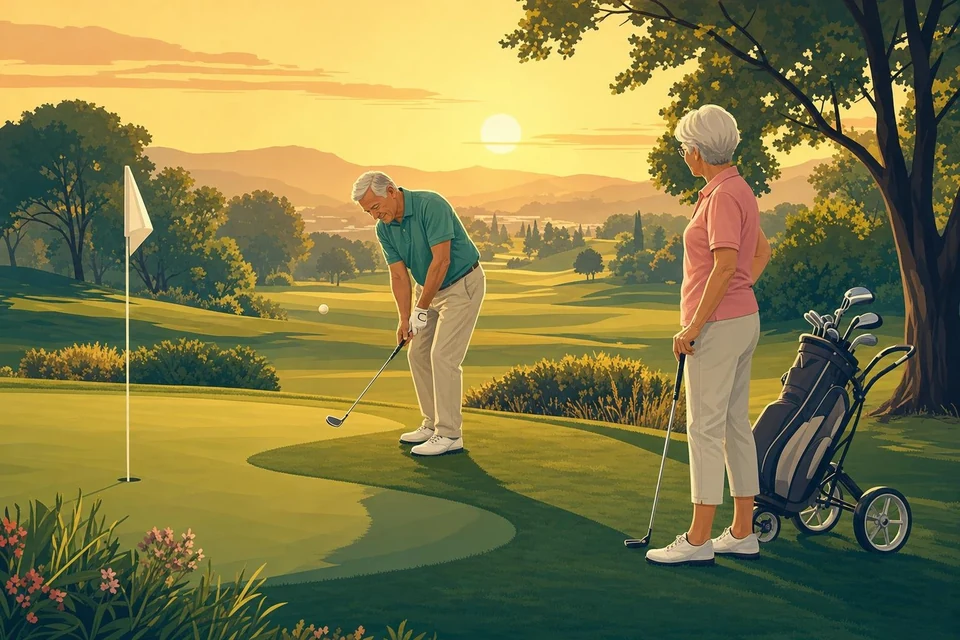
Golf is one of very few sports that people genuinely take up in their sixties and seventies, and keep playing for decades. Plenty of club members now in their eighties hit their first ball after retiring. Nobody expects a late starter to hit it 250 yards, and the handicap system means a beginner can play fairly with friends who have played all their lives.
Starting later does change a few things, though: how lessons are best structured, which equipment makes the game easier, and how much golf to play at first.
Lessons for seniors
The coaching itself is not fundamentally different. Grip, set-up, a simple swing, then the short game. What changes is the starting point. A coach working with an older beginner will ask more questions about flexibility, previous injuries, joint replacements and fitness, and then build a swing around what the body actually does, rather than trying to copy the full shoulder turn of a professional.
That usually means a shorter backswing, a wider stance for balance, and a focus on rhythm rather than speed. Many older golfers find that a smooth, unhurried swing sends the ball surprisingly straight, and straight is worth far more than long.
- Shorter backswingBuilt around how the body actually turns.
- Wider stanceMore balance through the swing.
- Rhythm over speedA smooth swing sends the ball straighter.
Most PGA professionals teach seniors regularly, and some clubs run dedicated seniors’ academies or daytime beginner groups that tend to attract retired people. Daytime sessions are quieter and cheaper at many venues, which suits anyone with a flexible week. The general advice in the guide to golf lessons for beginners applies here too, including starting with a group and moving to individual lessons later.
Short game deserves extra attention. Around half the shots in a typical amateur round are played within a hundred yards of the green, and putting and chipping depend on touch rather than strength. Older golfers who work on them often score better than younger players who hit the ball much further.
of the shots in a typical amateur round are played within a hundred yards of the green, where touch counts for more than strength.
Adapting swing and equipment
Equipment has improved a great deal for golfers with slower swing speeds. Lighter shafts, more flexible shafts in senior or lady flex, larger club heads that forgive off-centre hits, and hybrids in place of long irons all make the ball easier to get airborne. Many seniors find a hybrid far easier to hit than a 4- or 5-iron, and some carry no long irons at all.
Grips are an easily overlooked detail. Thicker or softer grips reduce the squeezing needed to hold the club, which matters to anyone with stiff hands or arthritis. They are cheap to change.
A club fitting is worth more for a senior starting out than for most beginners, because standard off-the-shelf specs are built around younger, faster swings. A fitter measures swing speed, height and posture and can recommend shaft flex, length and loft; the page on custom fitting explains how a session works. For background on what each club in the bag does, see the guide to the various types of golf clubs.
A trolley, ideally an electric one, takes most of the physical strain off a round. Carrying a full bag for eighteen holes is unnecessary for anyone, at any age.
- Lighter shafts in senior or lady flex
- Larger, more forgiving club heads
- Hybrids in place of 4- and 5-irons
- Thicker or softer grips
- Lower-compression balls
- A club fitting before buying
- A trolley, ideally an electric one
Nine-hole golf
The idea that real golf means eighteen holes is fading. A nine-hole round takes roughly two hours, and the World Handicap System, in use in Great Britain and Ireland since 2020, accepts nine-hole scores for handicap purposes. England Golf and the R&A have both encouraged nine-hole golf as a more manageable format for people with limited time or energy.
- ~2 hfor a nine-hole round
- 54holes of scores for a first Handicap Index
- 2020World Handicap System in Great Britain and Ireland
For a newcomer in later life, nine holes is the obvious place to start. It is long enough to feel like a proper round, short enough to finish feeling good, and many clubs run nine-hole competitions or roll-ups on weekday mornings. Pay-and-play nine-hole courses are also easier to book and less intimidating than championship layouts. Understanding a handful of the rules of golf – especially around pace of play and when to pick up – makes those first rounds much more relaxed.
Health aspects
Golf has attracted serious academic interest. An international consensus statement on golf and health, led by researchers at the University of Edinburgh and published in the British Journal of Sports Medicine in 2018, concluded that golf can provide moderate-intensity physical activity and is associated with benefits for physical and mental health, including for older adults. Walking an eighteen-hole course covers several miles, and the social side of the game is a real part of its appeal.
That said, golf is not risk-free, and the research does not make it a treatment for anything. Lower back, shoulder and wrist problems are the most common golf injuries, often linked to poor technique or doing too much too soon. Anyone with a heart condition, recent surgery or a joint replacement should talk to their GP before starting, and tell their coach. Warming up before a round, even for five minutes, is sensible at any age and essential later in life. Sun protection and staying hydrated on summer rounds matter more than most people think.
Before the first lessonA heart condition, recent surgery or a joint replacement is a reason to talk to your GP first, and to tell your coach.
The pacing advice is simple: start with range sessions and short courses, build up to nine holes, and only then think about eighteen.
Finding company on the course
A surprising number of seniors who take up golf say the game itself was the second reason. The first was company. Seniors’ sections at clubs, often with weekly midweek competitions, are among the most active parts of many golf clubs, and they tend to welcome new players warmly.
Women starting later have a further option in women-only groups, which the page on ladies golf lessons covers.
There is also the grandchild factor. Plenty of older golfers end up taking grandchildren to the range or the par-3, and a few find themselves being out-putted by a nine-year-old within the year.
FAQ
Frequently asked questions
Are buggies allowed for older golfers?
Most courses have buggies for hire, though some restrict them in wet weather to protect the turf. Golfers with a medical need can often arrange buggy use in competitions too, so it is worth asking the club directly.
What are seniors' tees?
Many courses have forward or intermediate tees that shorten the course without changing its character. Under the World Handicap System any rated tee can be used for handicap purposes, so playing a shorter course does not mean giving up a valid score.
Is it too late to get a handicap at 70?
Not at all. A handicap index is available to anyone who returns scores from 54 holes, in nine- or eighteen-hole rounds, and the system is designed so that beginners and older players can compete fairly with everyone else.
Do senior golfers need softer golf balls?
Often it helps. Lower-compression balls feel softer off the club face and can fly a little further for players with slower swing speeds, and they tend to be cheaper than tour balls.