Learning
Golf Lessons for Beginners in London: Prices and What to Expect
How a beginner in London finds golf lessons: PGA coaches, group or one-to-one, taster sessions, typical prices, kit and what the first lesson covers.
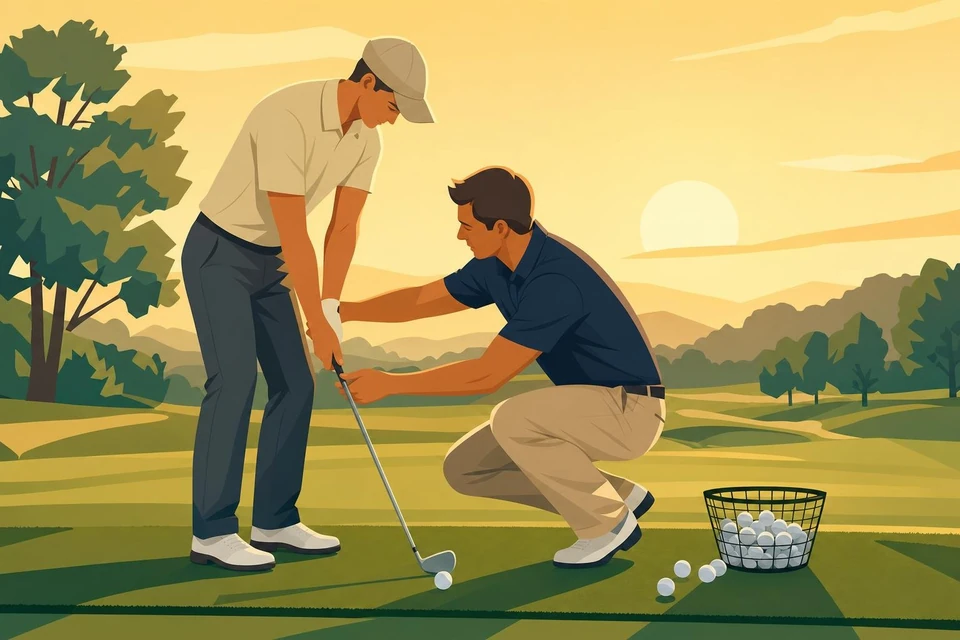
Most adults who take up golf in London do it backwards. They borrow a set of clubs, spend a few evenings hitting balls at a range, pick up a slice that sends half of them into the side netting, and only then book London golf lessons. By that point the coach has two jobs: teach the swing, and undo the one that has already set in. Starting with golf lessons for beginners from day one is cheaper in the long run, and a lot less frustrating.
This page walks through how that first step actually works in the capital – who teaches, how lessons are structured, roughly what they cost, what to expect from the first session, and how long it takes before a round on a proper course makes sense.
Who teaches beginners in London
The bulk of coaching in the UK is done by PGA professionals, members of the Professional Golfers’ Association who have gone through its training and qualification route. Most golf clubs employ at least one, and the larger driving ranges run academies with several on the staff. The PGA keeps a search tool for finding a qualified coach by area on its own website, which is a sensible first check if a name on a range noticeboard is unfamiliar.
There are also unqualified or differently qualified teachers: former elite amateurs, coaches certified by other bodies, and a growing number of people who teach mainly through simulators. Some of them are very good. The PGA badge is not a guarantee of a great teacher, but it does mean safeguarding checks, insurance and a recognised training route, which matters more than most beginners realise.
A map search for beginner coaching in almost any London postcode will throw up three kinds of venue. Golf clubs on the edge of the city, from the north London suburbs out to Surrey and Essex, often teach non-members. Stand-alone driving ranges are the most common entry point, with coaching bays, floodlights and long opening hours. Then there are the entertainment ranges such as Topgolf, which have coaches on site at some locations but are built around a night out rather than a learning programme. The longer guide to the driving ranges around London covers the difference in more detail.
Group or one-to-one golf lessons for beginners
This is the first real decision, and the view here is that most complete beginners should start with group golf lessons.
Group golf lessons usually run as a course of four to six weekly sessions, with somewhere between four and ten people and one coach. The coach introduces the grip, set-up and a short swing, then moves on to chipping and putting, and the last session often includes a few holes on a short course or par-3. You get less individual attention, but you also get a structure that someone has thought about, and the pressure is low. Watching other people struggle with exactly the same things is oddly reassuring.
One-to-one lessons suit people who already know they want to commit, or who have a specific problem – a back that does not like rotating, an old injury, a strong preference for learning by video. They are also the right choice after a group course, when the coach can work on what you personally do rather than on what the group needs.
Some coaches offer a taster session: a single, cheaper half-hour aimed at people who have never held a club. It is worth taking one, if only to find out whether you like the coach. The relationship counts for more than any particular method, and switching teacher after a single taster is perfectly normal.
Taster session
A single, cheaper half-hour for people who have never held a club.
- Low cost, sometimes free with a course
- Shows whether you like the coach
- Too short to build a swing
Group course
Four to six weekly sessions, four to ten people, one coach.
- A structure someone has thought about
- Low pressure, often ends on a par-3
- Less individual attention
One-to-one
Lessons built around what you personally do.
- Suits injuries and specific problems
- Ideal after a group course
- Costs more per session than a group
London golf lessons: typical prices
Prices vary widely across the city and depend on the coach’s experience, the venue and the time of day. The ranges below are typical for London golf lessons and should be read as rough guidance, not quotes from any particular venue.
| Format | Typical London range |
|---|---|
| 30-minute individual lesson with a PGA professional | roughly £35–£75 |
| 60-minute individual lesson | roughly £60–£130 |
| Group beginners’ course, 4–6 weekly sessions | roughly £60–£180 per person |
| Taster session | often £15–£40, sometimes free with a course |
| Bucket of range balls for practice | roughly £5–£15 |
Several things push up the price of golf lessons for beginners. Senior coaches with tour or national-team experience charge considerably more. Lessons that use launch monitors and video analysis cost more than those on a plain mat. Weekend and evening slots go first and are sometimes priced higher. Lesson packages, typically five or six sessions bought together, bring the per-lesson cost down, and coaches generally prefer them because a single lesson rarely changes much.
The hidden cost is practice. A lesson on its own fixes very little; the time spent repeating the drill afterwards does the work. Budget for at least one practice session between lessons, which in London means a bucket of balls and the travel to get there.
What to expect from a first lesson
A good first lesson involves surprisingly little full swinging. Expect the coach to ask about your sporting background, any injuries and what you want from the game, because that shapes everything that follows. A former cricketer and someone who has never played a ball sport need very different starting points.
The first practical work is nearly always the grip and the set-up: how the hands sit on the club, how far to stand from the ball, where the ball goes in the stance. It feels fiddly, and it is the part beginners most want to skip. After that comes a small swing, often hip height to hip height, hitting a short iron. Many coaches start with a few putts or chips instead, partly because quick success keeps people coming back.
By the end of thirty minutes you will not have a golf swing. You should have one or two things to practise and a clear idea of what the next lesson will cover. If you leave with a list of ten swing thoughts, that is a warning sign about the teaching, not about you.
From the practice teeLeave each lesson with one or two things to practise. Ten swing thoughts at once means the lesson tried to do too much.
The second and third lessons are where it starts to click. Contact improves, the ball goes up more often than it skids along the ground, and the coach can begin to introduce longer clubs.
Kit for the first few months
Very little. Coaches lend clubs, and ranges supply balls. Comfortable clothes and flat trainers are enough on a mat. A glove is a cheap and useful first purchase, and so is a single 7-iron for practice.
After a handful of lessons, a half set or a second-hand beginner set makes sense. The guide to the various types of golf clubs explains what each one does, which saves money at the till. A custom fitting is worth considering later, once the swing is reasonably repeatable; before then, the measurements change as fast as the technique.
How many lessons before playing a course
There is no fixed number, and coaches disagree. A fair rule of thumb: after a group course plus a few individual lessons, most adults can get round a par-3 or a nine-hole pay-and-play course without holding anyone up. That is usually somewhere between six and ten sessions, spread over two or three months with practice in between.
sessions, over two or three months, before most adults can get round a par-3 or nine-hole course without holding anyone up.
A full eighteen-hole course is the next step. What tends to matter is not distance but pace: being able to hit the ball forward reliably, knowing when to pick it up and move on, and understanding enough of the basic rules of golf to avoid holding up the group behind. Many clubs run beginner-friendly playing sessions or welcome nine-hole rounds at quieter times, and those are a gentler introduction than a Saturday morning medal.
Women who prefer to learn alongside other women will find that many London venues run separate academies; the ladies golf lessons guide covers those. Anyone starting later in life may also want to look at how coaches adapt for older beginners.
Choosing between the options
If the choice is between two coaches and one of them simply listens better, choose that one. The method matters far less than whether you go back for a second lesson.
For a complete beginner in London, the sensible sequence looks like this: a taster with a PGA coach at a range close to home or work, a group course of four to six weeks, then a short package of individual lessons once you know which parts of the game feel hardest. That route costs a few hundred pounds over a season, which is less than many people spend on clubs they then use badly.
- Book a tasterA half-hour with a PGA coach at a range close to home or work.
- Join a group courseFour to six weekly sessions covering grip, set-up, chipping and putting.
- Add a few individual lessonsA short package aimed at the parts of the game that feel hardest.
- Play a par-3 or nine holesA pay-and-play course at a quiet time, once the ball goes forward reliably.
- Move up to eighteenA full course, ideally at a beginner-friendly session rather than a Saturday medal.
Coaches who teach golf lessons for beginners point to one odd detail: people who keep a short note after every lesson – one line on what was covered, one on what to practise – improve noticeably faster than those who rely on memory. It costs nothing and almost no one does it.
FAQ
Frequently asked questions
Do I need my own clubs for a first golf lesson?
No. Almost every coach and range academy lends clubs for the first few sessions, usually a 7-iron and a wedge to start with. Buying a set before you know how you swing tends to mean buying the wrong lengths and lofts, so it pays to wait until a coach has seen you hit balls.
Is it better to learn on a driving range or at a golf club?
For the very first lessons a range is usually easier: floodlit bays, balls on tap and no one waiting behind you. Once the basics hold up, a club or pay-and-play course becomes useful, because the short game and playing from real lies cannot be learned from a mat.
How old is too old to start golf lessons?
There is no upper limit worth worrying about. Coaches regularly teach people in their sixties and seventies, and they adapt the swing to how the body moves rather than forcing one model on everyone.
Can I book golf lessons for beginners as a couple or with a friend?
Yes, and many coaches price a shared lesson only slightly above a solo one. It works best when both people are at roughly the same stage, otherwise one of you ends up watching for half the session.
What should I wear to a beginner golf lesson?
Comfortable trousers or shorts, a collared top if the lesson is at a members' club, and flat trainers. Spikes or golf shoes are not needed on a range mat, and in winter a few thin layers beat one heavy coat because you need to rotate freely.